"Modern" Orchestra Line-Ups
Added 2021-05-21 06:56:12 +0000 UTCIf you compare orchestral scores from today with the ones from a few decades ago, you will very quickly notice that at least in the big budget productions we see an excessive growth of orchestra sizes, particularly obvious in the brass sections.
It is not uncommon to see line-ups that extend even beyond Mahlerian orchestras with 12 Trombones etc. Additionally, sample developers more often release virtual instruments that come with ensemble sizes that are beyond anything "reasonable" by traditional standards. Just think about the JXL Brass by Orchestral Tools (including samples by section sizes of 12 Horns, 12 Trumpets, 12 Trombones etc.) or Spitfire Audio's Hans Zimmer Strings with 344 String players sampled.
And even in more traditionally written scores like the ones from John Powell we see line ups that are beyond a "large symphonic line-up". For example HOW TO TRAIN YOUR DRAGON has 12 Horns and 6 Trombones.
Having said that, such line-ups are not new inventions. Especially more modernist composers like Bernard Herman experimented with odd and excessive line ups (e.g. 12 Flutes for TORN CURTAIN). However, these were relatively rare and very often were used to create a very specific sound world for a specific score.
So the big question is why we see such a development. I think it is not boiling down to just one reason but there are probably several reasons for this development. I personally see four main reasons:
1. Epic Music
The incredibly popular and commercially successful sub genre of "Epic Music" or "Trailer Music" is a driving factor here. Basically it is high energy orchestral music, often with support by percussion or electronic elements and very often at the upper dynamic limit of acoustic instruments, especially brass. In order to create that sheer size impression and "wall of sound" that this genre finds desirable, it is mandatory to extend the line-up, especially in the brass section. As this esthetic approach has extended into films now, we see such line-ups quite commonly in film scoring sessions with composers like Junkie XL, Hans Zimmer or more broadly from Remote Control spearheading this genre.
2. Recording Technology
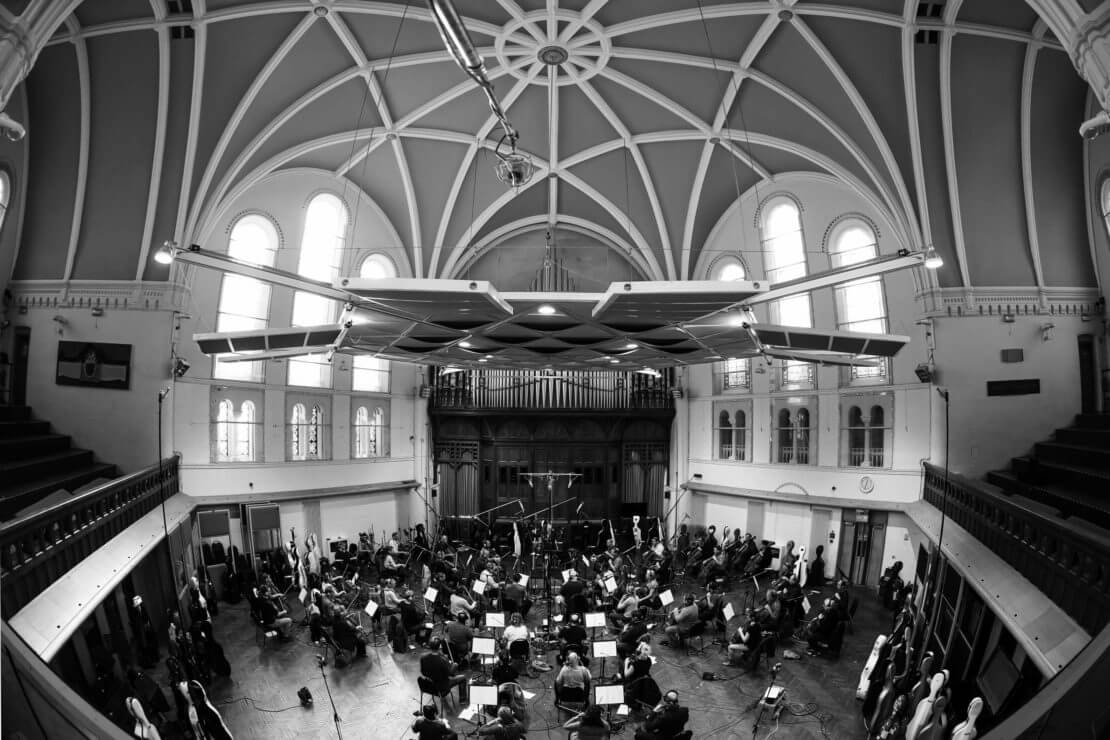
It is not necessary anymore to record the entire orchestra in one pass. In earlier times of recordings the limit of available channels just made it necessary to record all instruments at once in the same room, which required a balanced writing so that no section would drown out the other on the recording. Therefore, it was essential to keep proportions in an orchestra that would work in an acoustic space. Just adding 12 Trombones to a medium sized string section would have eliminated any balance in the recording. The possibility to record sections or sometimes even players individually and mix them together digitally has created way more freedom in ensemble sizes. You can still have the "epic sound" of 12 horns in a "standard sized" orchestra without them drowinging everybody else because you can record them separately and have the benefit of the big sound without the disadvantage of them dominating everything else. Additionally, this technology also allows to use the room more creatively. In a full orchestra recording, even the largest recording venues on this planet only allow a limited possibility of re-seating players or re-purposing the stage. If you record your Brass or Horn section individually, you can do things that are way more adventurous. For example in a Studio like Air Lyndhurst which is located in a former church you can use the galleries as part of your recording concept. For instance in Gladiator, Hans Zimmer placed 16 Horns in this room with groups of 4 each with one group at the "regular" stage and 3 groups located at the galleries. By that you of course get a very wide and spaceous sound that extends way more in the stereo field than what you would get if you recorded all 16 horns on the stage. So the possibility of this separate recording approach allows you to get way more musicians into the room and use the space way more effectively. The esthetics of modern film scoring like this "hyped" sound that is larger than life in all regards.
3. The lack of craftmanship in Orchestration
Now this applies not for all composers who record large ensembles but there definitely is a group of composers who love to compensate their lacking skills in orchestration by sheer masses of players. A well orchestrated very small ensemble can sound bigger than a poorly orchestrated orchestra of epic proportions. Yet, some composers are under the impression that size in sound is directly proportional with ensemble size so they solve the problem by hiring more musicians rather than working on their orchestration chops.
4. Pop approach
Many of the composers mentioned in the previous points have a different upbringing and often have a history of being a band musician or producer applying a set of expectations to orchestral instruments. And while it very tricky for acoustic instruments to create a similar energy and immediate impact as amplified band instruments or synths, they try to compensate this by specific processing and recording techniques as well as hoping to find this "edgy sound" in larger ensembles
As a bottom line, I would say that all these points can be grouped together in "esthetic development" of media music. None of the approaches would be successful if it weren't for filmmakers and audiences who appreciate this sound. And seeing that the audience size of "epic music" has already outgrown the traditional film music audience there of course are enough commercial reasons to keep going that way. We live in times where the esthetic ideal often is a minimalist musical approach paired with a maximalist sound approach and the line-ups we see in scores these days are just a testimony of that.