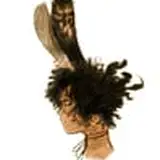
1. In the early rough sketch, I decide on the general shape of the hairstyle I want. I often try multiple styles before choosing one.
2. For sausage curls, the first step is laying the general path of each curl as a whole. I don't worry about the actual curls, just the path along which each whole sausage hangs.
3. Next, I go in add a few special, key curls as cylinder shapes. The idea here is to ensure that I have just a few particularly irregular places on the curls, places where the curl has a significant gap, bends in a special way to match the curve of the path, or juts out significantly to create a more natural, irregular feel to the curl. It's useful to do this for all of the curls at once so that I can make sure that the irregularities are distributed across the different curls in such a way that they won't interfere with each other. It can be useful to look at photographs of sausage curls for ideas.
4. Then I refine just those special curls from cylinders into more detailed, hollowed shapes.
5. Next, I add just the outer edge of each curl, connecting up the irregular shapes, using a random bumpy line. It's important to make sure that the bumpiness isn't very regular, with a lot of variety in distance between and size of bumps. I also try to include a few very sharp V-shaped inward pointing dips here and there.
6. Now I rough in the more detailed strokes of the hair, using the dips between bumps to guide me. The big V-shaped dips are used to make places where a curl loops out large enough the you can see inside the curl a little.
7. Then I go back and refine the sketch, making sure that the lines make sense and that the lines from one curl don't tangent weirdly with the lines from the next curl.
8. With inking, I draw the full outer edge of each curl first, using a heavy, blunt-edged line.
9. They I go back and use a finer, pointy line to add in all the inside detail. The contrast in thickness between edge and detail helps each curl to stand out clearly as its own shape.