Bucchigiri?! Lacks Utsumi Hiroko’s Signature Style, Heart, and Soul
Added 2024-06-09 03:06:13 +0000 UTCAuthor: Elif Sinem Erdem
Editor: Alex Henderson
“Swimming anime”—that tag briefly appeared all over Tumblr in summer 2013, featuring four scantily clad young men around a pool. It was initially unclear to me what the CV by legendary studio Kyoto Animation was for. In the thick of August and without any awareness of the ad’s relation, my brother and I watched the first three episodes of Free! Iwatobi Swim Club, right after we saw the first season of Kuroko no Basket together. Our desire was to see an anime about competitive swimming, which we got, but Free! is much more than that. This anime, loosely based on the light novel series High Speed!!, is over-the-top, homoerotic, and unceasingly earnest. It rocked my sixteen-year-old self and kept me going back to seasonal anime for over a decade; specifically, to her anime: the work of director Utsumi Hiroko. Following Free! was Banana Fish (her only manga adaptation so far, and the first of many works for the studio MAPPA) in summer 2018, and Sk8 the Infinity in winter 2021. Bucchigiri?!, which aired this winter, is her latest—and markedly different.
Over her career, Utsumi has established a signature style with a few key ingredients: driven protagonists, homoerotic entanglements between the main male characters, themes of passion and youth. Then there’s the less favorable elements, such as her female characters often being shallow and sidelined, as well as the occasional grab at a fetishized version of Middle Eastern aesthetics. Bucchigiri’s trailer is drenched in the latter, featuring an incredibly muscular character, and a thinner, weaker counterpart, as well as multiple potential villains. But besides that, already one can tell the departure from her earlier works—the most notable of which being that there’s no sport featured here. However, considering her grip on interpersonal dynamics and storytelling, upon this series’ announcement I was still confident this would not stray too far from the likes of Sk8 (in which skateboarding tournaments are held illegally) and Free (in which swimming is tantamount to life and death). It was an anime about fighting, so it would, like Utsumi’s other works, be an anime about passion. Right?
Instead, what I got was an unevenly paced, twelve-episode anime that went against every convention that Utsumi set up for herself—chief of which is that it features an utterly unmotivated and aggressively heterosexual main character. Bucchigiri?! is not just odd for an Utsumi anime: without the key elements of Utsumi’s earlier works, it ultimately falls short as a story, one seemingly bereft of a heart and soul.

Romantic, isn’t it? Utsumi Hiroko’s vision of youth
In her original work, passion is always key, both for the characters and their relationships with each other. Usually a sport takes center stage, and the protagonist, always a young man, is consumed by it since childhood. The timeframe is typically centered around a grand tournament and the anime combines the final with the climactic final episodes. The sport is the protagonist’s world, filled with characters of colorful personalities, easily described in one phrase (“calm”, “loud”, “wears glasses”), but the most important one is his sidekick—a friend or rival, perhaps both, always another young man.
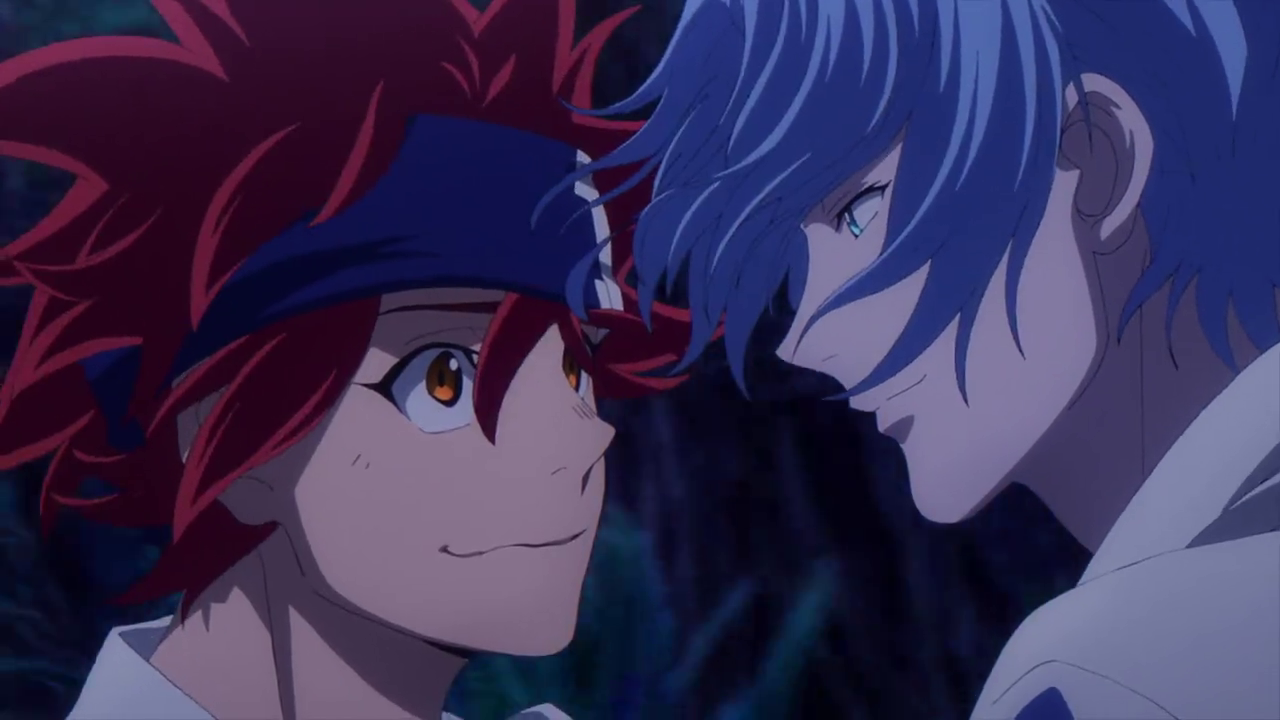
As early as Episode 2, one of them will be seen in his perfect form, reflected in the other’s eyes in an extreme closeup. He may not think of himself as cool or grand, but is seen that way by others—most importantly, he is seen that way by his best friends. This is precisely where Utsumi wrings out something close to the notion of soulmates, destined pairs whose relationship dynamic helps drive the plot. (In Free’s first season, one of the lines that is often repeated is, “Romantic, isn’t it?”)

The deuteragonist will contrast the protagonist visually, in personality—being the red to his blue or vice versa—and push him to his limits; in turn, the protagonist will demand as much from the sidekick as well, a point of friction culminating in a final fight (mostly verbal, sometimes even physical) that is delivered with gravitas. One or both characters are, by this point, sensitive and prone to burst into tears. With a climactic, emotional realization that these characters mutually need each other, they reconcile at the end, work together to achieve their common goal, and become friends again. The sole female characters around are mothers and sisters. Fathers are dead or entirely absent.
Despite Free being Utsumi’s directorial debut, it already bore all stylistic hallmarks that were initially derided and later celebrated. Because of the importance of the relationship and the simmering passion between the red and blue characters, it’s been called gay, even “fujobait”—meant to appeal to girls shipping boys. And it is true that to like a work directed by Utsumi means to wholeheartedly accept, even embrace, the inherent homoerotic subtext even if it might not unfold into a traditional full-fledged romance. But past these cheap thrills, the viewer is rewarded by a climax that boasts both a strong pace and catharsis, thanks to an ironclad sense of interpersonal dynamics. As well as themes of passion, friendship, and realizing the future you want to achieve, all abound and reminiscent of the YA literary genre, these works truly do boast substance. Yes, it is perhaps doing too much—but aren’t we all at sixteen?
Bucchigiri, by contrast, lacks this stylistic passion, drive, and all the emotional energy that comes with it. Its first and most prominent weakest point is that its protagonist, Arajin, doesn’t care about his best friend and doesn’t even want to be the hero of this story. Most crucially, he is aggressively heterosexual.

I want to lose my virginity! Bucchigiri’s big swings
In Utsumi’s works, the first scene will define the series to come thematically, an undercurrent so strong that just about every episode is defined by it. Free begins with the overly serious monologue “The water is alive”; the show itself concerns itself with swimming and, more broadly, a passion for sport. Sk8 has Reki wonder aloud if anyone can ever be happy, and his arc is about losing and attaining happiness, again while centering it to skateboarding. As for Bucchigiri, we get Arajin introducing himself as a music-loving person who is single.
Bucchigiri follows Arajin Tomoshibi, who can’t stand his mother (a Chinese restaurant owner who always prepares him gyoza for lunch), and wants nothing more than to bag a girl. To that end, he initially dons glasses and brings a guitar with him on his first day transferred into his new high school (one can only assume it is to whip up Oasis’ “Wonderwall” at any given moment) but this wish is quickly thwarted in a world ruled by gangs and violence. Arajin, who has a history of training martial arts and, for much of the series, wants nothing to do with any of it, is roped into the action when a special bullet hits him at the temple. This unleashes Senya, a genie capable of giving extraordinary fighting abilities, better known as Honki Person. Senya asks for a wish; Arajin, over many episodes, will always say: “I want to lose my virginity!” (Spoiler alert: he does not.)

This is the core of Arajin’s character, the passion that supposedly drives him through the epic narrative: he is a teenaged boy who wants to have sex. Bucchigiri does not, in any way, concern itself with the intricacies of lying to oneself or unpack this wish of Arajin’s: at the end, rescuing himself from the darkness of unconsciousness, Arajin still shouts his usual wish of losing virginity. Bucchigiri is also not about the loss of virginity. It is about fighting, and Arajin rejects a fight every single time he is asked to do so. He is at odds with Utsumi’s other protagonists: Haruka (of Free), is so consumed by swimming and water he spends his days in a bathtub. Reki (of Sk8) helps out at a skateboard shop and skates whenever he has time. They are not sexual characters: girls never factor in their lives; their most important friend—their counterparts with whom they have all that homoerotic tension—is usually just as consumed by the sport as they are. If Arajin has any kind of connection with previous shows, it is perhaps Free’s Makoto Tachibana, Haruka’s childhood friend who fears the open sea and is more concerned with Haruka’s well-being than competitive swimming.
Except Arajin doesn’t care for his childhood friend, either. Matakara Asamine, who desires to become a Honki Person, holds Arajin in high regard. After all, the two once shared the same dream, but Arajin, upon seeing his friend beaten up by teenagers, left Matakara for dust and the dream to die. Over the course of many episodes, Matakara will approach Arajin with a Golden Retriever smile and call him “Ara-chan”, only for Arajin to shrug him off. One would think the characters would evolve past this—after all, Haruka also shrugged off just about everything in the first three episodes of Free—but Arajin’s disdain remains consistent over twelve episodes. An emotional plotline about Arajin feeling guilty about leaving his old friend emerges, but quickly disappears as it soon becomes clear that Arajin’s singular interest is girls.

One key to the series is Mahoro Jin, Arajin’s crush and sister of gang leader Marito, who wants her brother for herself as much and often as possible. Similar to Arajin disregarding Matakara, Mahoro disregards Arajin from Episode 2 on, and is even disgusted by his numerous attempts to hit on her (usually with a soulmate stone). Marito, meanwhile, disregards Mahoro, too. He both loves and is bored by leading Sigma, one of two gangs ruling the school, only around to fight someone strong. Arajin, who happens to be strong solely because Senya is inside of him, joins his gang because Mahoro coaxes him to. The archetypal “Call to Action”, as detailed by Joseph Campbell’s Hero of a Thousand Faces, this is not. Arajin will have to be goaded into fighting every single time. Again, Haruka had this for a little while, but never when it came to his core motivation: swimming “free”, both the shorthand of freestyle and freedom, enjoying his passion with his friends unburdened by anything. Reki never once wavered in his belief or desire to be happy through skating, though he soon felt discouraged from trying his best upon seeing the naturally talented rookie Langa. Arajin, though? He hates it here.
Bucchigiri establishes a herky-jerky formula: violence happens, Arajin refuses to be part of it (even develops debilitating stomach ache, looking for restrooms that are often absent), is goaded by Mahoro (directly or indirectly) to fight, and must eventually deliver the final punch to the villain of the episode. What initially starts out between Arajin and Matakara as a possible exploration of a friendship and the repercussions of betrayal fizzles out only to come back too little, too late. When Matakara’s older brother is stabbed in prison, Matakara succumbs to darkness and despair, threatening to be overtaken by another Honki Person—Senya’s erstwhile partner, Ichiya.

In other Utsumi series, the bond between the male characters is strong throughout, culminating in an explosive finale; unlike its successors, Free features Rin seeing Haruka’s perfect swimming form in a closeup only at the season finale. This was “the sight he’s never seen before” all along, the “free” swimming Haruka has always strived for, a satisfying finish of twelve episodes chock full of mutual, homoerotic push and pull. So one would think Arajin would, for once by his own volition, jump into action at his childhood friend going evil. He doesn’t. Once again Mahoro asks him to; upon an initial “No”, she rejects him more cruelly than ever before. That is what makes a heartbroken Arajin determined to set things right.
Meanwhile, Mahoro herself is at the hospital, caring for her brother, who had been previously beaten up by Evil Matakara, away from the final fight that ensues. Watching Arajin, the protagonist, begrudgingly participate in the plot left me feeling tired of the whole of Bucchigiri in turn. It’s like forcing an unwilling friend to come see a movie with you. In between, there’s mini-arcs of gang leaders trying to fight Arajin, one in particular concerned with starting a gang war, but since Arajin doesn't care, nor grows or learns anything from it, one is left to ask multiple times why Matakara, or even Senya, couldn’t have been the main character—the ones actively (and emotionally!) involved in everything happening.

That’s just your natural potential: Bucchigiri’s big misses
The most important thing to any narrative is the strength of its protagonist’s voice, whether it is a highbrow, plot-less work or anime that hews closely to shonen conventions such as Bucchigiri. Voice, to me, means possessing a unique perspective to the exterior world, and for a perspective to emerge, a character must want something and earnestly try to attain that. Hiroko Utsumi’s protagonists embody their desire, no matter how foolish or juvenile it might look at first glance; all but Arajin, who, by refusing and rejecting the plot, seems like a passenger in the story he is ostensibly meant to drive.
If the focus was really romance, this wasn’t the story to tell it with; if he really wants sex, I want to see him get it, even if that changes the genre of Bucchigiri from shonen to ecchi. I asked myself multiple times if the guitar, or even his practice of stone-carving, would return; past the second half, it doesn’t. His defining character traits are that he likes girls and doesn’t want to fight, and he remains in this static state—no additional depth, no character development, no climactic change of heart—for the whole series. And again, the guy doesn’t even get the one thing he wishes for. So what’s the story about?

And what to do about his rejection of Matakara? Where to place the climax at the end, when Arajin does fight and does become the Honki Person that Matakara saw—like Reki saw Langa, and Ash Eiji—in Episode 2? Because Arajin doesn’t want to hang out with Matakara between Episode 2 and 12, who reminds him of his childhood failure, there is not much to base their relationship on besides moments in time that happened prior to the story taking place. Making dumplings together is a rare moment of reprieve—from Arajin, that is, because he isn’t asking Matakara to leave for once. One gets the bizarre sense that, because Arajin is into girls, he can’t hang out with other guys, least of all with his taller, beefy childhood friend. It gets both in the way of plot and of a good character dynamic, something that previously marked every work by Utsumi and had powered so much of the series: voice, plot, and its emotional beats.
Elements of rejection and refusal are not new in Utsumi’s works: the stories are dependent on it. In Sk8, Reki refuses to skate because he considers himself worse than Langa; accordingly, this episode and subsequent fight with Langa is painted in rain and drab colors, and marks an altogether heartbreaking moment. In Free, in a first of many times, Haruka rejected Rin—in fact, Bucchigiri mirrors this moment visually—but the world of competitive high school swimming is small, and prefecture competitions even more so; Haruka has no choice but to face Rin and face what it is that he wants from swimming. Sk8, too, circles back on what it is that Reki—and Langa—want from skating: their mutual company, fear transforming to thrill and, eventually, to fun.

Bucchigiri takes rejection and refusal to an extreme. One never gets the sense that Arajin has no choice but to face Matakara; Arajin could always walk out without facing any repercussions, and always does. There is nothing he wants from fighting. For this same reason, Mahoro—his actual motivation—has to goad him to everything. As for the thing that Arajin ostensibly wants, any potential romance between him and Mahoro falls to the wayside by the end. Not only is Mahoro the worst female character in an Utsumi work yet, veering uncomfortably close to a stereotypical “female manipulator” role, but the big plot beats hinge on Matakara, not her. We find out (far too late) that he wants to dispel the shadows by fighting: the big, black shapes that threaten to swallow him and his brother whole and leave him by himself for eternity.
In all, one gets the sense that for Bucchigiri, Utsumi Hiroko wanted to go against what she’s known for. Gone would be the character that was completely into the centerpiece of the story: swimming, skating, and now fighting. Instead, this protagonist would reject it. On one hand, this would lead to comic moments. On the other hand, this decision fatally highlights Utsumi’s weaknesses in her writing. Mahoro, a manipulative brocon character, does nothing more than nudge Arajin to action. The side characters look good and have vague traces of shared history, even get paired off for convenient shipping purposes, but don’t develop beyond their stereotypes. Matakara’s character arc, in which he succumbs into darkness and must be rescued—itself a horrifically flat rendition of grief!—feels taken straight out of either Yu-Gi-Oh, Digimon or Beyblade, and bookends the show that finds enough time to put its own spin on the Beach Episode (training camp) and everything besides sensitive, sensible plot moments.
It’s not that Free or Sk8 broke ground with plot, only ever in its audacity to be this much for the girls, but they had a beating heart in the main couple. I struggle to see how Bucchigiri could be for girls, if it is for anyone. There is nothing to ship, either, because Arajin wants nothing to do with Matakara. That deliberate rejection leaves a vacuum. Without Arajin, the protagonist, driving the events alongside Matakara in a conjoined force, without the show thematically trying to answer the questions that haunt teenagers (and adults!) through the two growing closer, without that indelible gay subtext that made all her works so poignant and high octane, Bucchigiri fell flat on all accounts. I walked away feeling profoundly disappointed, not only in the anime and more broadly Utsumi, but in myself: because I know I will be there for her next project just so I can once again chase the highs that the swimming anime gave me a decade ago.