Kanin Fyre: Chapter 15 - Hunted
Added 2025-07-21 12:00:16 +0000 UTCWe lope through the woods without any destination or goal in mind; it feels good just to be moving. Makes it easier to pull our mind away from the frustrating interaction with the void mage. Out here, we can just be.
The forest floor is dusted with snow, and each footfall disturbs the soil beneath and leaves a print in the ghostly white glade. The world sounds muted, and the air still.
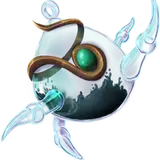
We cut through it with great leaps, our irritation feeding our speed as we push ourself to go faster. A dead branch lays in the path ahead of us. We could go around, but instead we whip our sphere of Chained glass around us, crashing into the branch and splintering the wood into tinder. Slivers ping off our glass as we rush through the gap.
Satisfaction blooms within us. It feels good to break something, while not having to worry about breaking ourself. It’s a good outlet for our frustration. We look for more things to attack—bark to sink our claws into—branches we can slice through. We put everything we have into it, moving and attacking as quickly as possible. Our form gradually shifts as we do, glass rearranging into different shapes as needed, forming extra limbs or combining them. The freedom of not being constricted to one form is exhilarating. Shards of glass not directly Chained to our main body swirl behind us like a flurry of snow.
Eventually, we slow. We aren’t tired, but we’re putting a dent in our mana stores, and our frustration has gradually bled away into disappointment. We came all this way and even found the person we were looking for, only to be told to come back in a few years. We had hoped for more. We were eager to learn new ways to utilize our void.
We scoff, indignation blooming within us. Who needs a master, anyway? We’ve made it this far on our own. We’ve discovered a few void spells on our own already. There’s no reason we can’t find more.
As we slow to a stop, each step produces the faintest hush of compressed snow and earth—it’s the only sound we can hear. Looking back, our manic target practice has left a very clear trail in the upturned snow. As a predator, we don’t like it. We should be silent. Leave no tracks.
We could. We should be able to. A large cluster of Chained glass levitates behind us like a balloon pulled along on a string. Even more bits of seeing glass hover around us, keeping watch in different directions. There’s no reason we couldn’t do the same with our body.
We’ve known this for a while, really. We’ve been able to levitate ourself before. It takes both elements working in tandem for everything to ‘click’ into place. The only reason we haven’t spent much time trying before now is…
It takes us a moment to admit it to ourself: flying isn’t human. This is another step away from our old identity. We feel that we’re losing it, piece by piece. Our body. Our voice. Our memories—even our mind isn’t our own, anymore. Not entirely.
But so what? A part of us pushes back. Why is being human better? Why is it bad to evolve? To grow? To become more than we were before? Don’t we want to become stronger?
We do. And we don’t have answers to those questions. It’s just something we’ve always implicitly assumed—to give up our humanity means we have to find a new way define ourself. And that’s frightening.
But in truth, we know it’s something we’ve already started to relinquish. We have been for a while. And this new version of us—this new existence—we don’t know what to make of it yet. We don’t know what our new identity is, or what it should be. Maybe that’s okay. Maybe that’s something that will come with time.
It’s certainly not something we can solve tonight. But something we can do is take this one step. Stop holding ourself back.
Focusing on precise control over our void and glass, we slowly lift one limb from the ground. Then another. (And another. And another. And another.) Only one limb is left still planted on the earth, and if physics had a say, it shouldn’t be able to hold us up. But it’s not holding us up: we are.
We lift the last limb and wait there for a moment. We don’t fall.
We’re floating.
We’re floating!
Despite a rising, giddy excitement, we carefully stretch out a few of our limbs, testing the limits of our movement while we remain suspended above the ground. This does take more concentration. It isn’t trivial. But before, we’ve only been able to float our body when we locked it into one rigid form: that provided us with fewer moving parts to think about. Even when we’re walking in our bipedal form, much of the void is keeping Chained portions of glass rigid so it takes less thought.
It’s definitely easier to move when we walk, because we can afford to let our legs support the weight of pieces we’re not actively controlling. Controlling every piece at once—or at least enough pieces to float—is a balancing act.
Though we suppose there’s no reason we have to choose between running and flying. Perhaps one or the other will better suit different circumstances.
We lower our limbs, settling back onto the ground. Let’s try something different.
We begin running once more, weaving around the trees in search of an obstacle. There—a low branch arcing toward the ground. We race toward it. And at the last moment, we jump.
As soon as we leave the ground, we shift to levitating our glass. We sail over the branch with ease. And instead of crashing back to the ground, where we might even sustain Fall damage from this height, we are able to lower ourself, slow and controlled, sailing far longer than the jump should have allowed. We touch back down, and keep running. Pride and exhilaration swirl through us. This is going to be fun.
We leap across a brook. We spiral up the trunk of a tree. We jump from branch to branch, alighting on twigs that should never be able to support our weight. We climb all the way up through the canopy this way, until we abruptly burst from the foliage, and the forest stretches to the horizon around us like a gently rolling ocean of leaves. We wrap a limb around the top branch, keeping us tethered as a breeze faintly brushes against us, and we sway with the swells of the woods.
It looks like a different world up here. Black and white, empty and open for miles and miles, like we’re on the surface of the Moon.
Lusio’s two moons are obscured by clouds, a faint glow halfway to the horizon divulging their hiding spot. We enjoy looking at the stars on this world—they’re so much brighter than we’d ever seen on Earth—but tonight the clouds and faint snowfall take their place. It has its own kind of beauty.
A twig snaps.
Our glass springs into action, swirling around us in a blizzard of our own making. We cast them beneath the leaves in search of whatever creature made the noise. We don’t like being oblivious to anything within our range, even if it’s nothing more than a field mouse.
But the woods are still. Our glass finds nothing. We settle our shards on branches and leaves, entirely motionless. We wait.
Nothing. Nothing that we can find, anyway. A pit of unease forms in our soul. Our instincts tell us we’re being watched.
Our void bristles. We are not prey to be hunted. We will not be bested by some other predator. They think they can sneak up on us? They will regret it.
We slide back down the trunk, senses tuned for the faintest flicker or whisper. The snow makes everything feel close. That should also help us find their tracks; assuming they can’t move the way we can.
We wait five minutes without moving. It feels a bit like the hide and seek matches we’ve done with Zyneth. We might have thought it was him instigating a surprise session, but he wouldn’t have broken Siqi’s windows just for that. No, this is something else.
When there’s no sound or motion save for the gentle snowfall, we begin to move our glass. We branch out, pushing the pieces further from our body in an expanding spiral. Our glass has a smaller range than our void, so if we find nothing nearby, we’ll try using that next.
Something stirs. It moves too fast for us to get a good look, but by the time we send glass to the tree trunk where we’d notice the movement, nothing’s there. Our mind pulls slightly apart, enough that we can use Echo for a Check. But even that doesn’t turn up anything.
Another flicker. This time we rush over, but again there’s nothing. We growl. Are they playing with us? Now we’re starting to get annoyed.
“Come out,” we call, the sound distorted and staticky as it emits from our translator. We can’t call very loud, but with how quiet the night is, our voice carries far.
We don’t expect a response—so we’re surprised when we get one.
“Well, this has been illuminating.”
A branch that had previously been empty abruptly holds a familiar silhouette. Siqi is sitting there casually, legs dangling over the side and head propped up by one hand.
That explains why we couldn’t find our pursuer. We shift some of our glass to keep a better eye on him, but he blinks away the moment they move.
“I suppose this is why you wanted to learn void magic?” he asks, now seated on a felled tree behind us. We don’t whip around, since we can already see him—and we don’t want to give him the satisfaction of thinking he surprised us. Instead, we take a seat as well.
“Why did you follow?” we ask.
We should separate. We need to be able to talk to him better—and we don’t like other people seeing us like this.
Why? This body is ours, no matter the form. We should be proud, not ashamed!
Mostly, though, we both feel annoyed.
“I sensed something wasn’t entirely right about your void,” Siqi admits. “And there were enough holes in your story, I knew I wasn’t getting the full truth. Thought I’d follow and see what you were up to. Think I learned a bit more than I bargained for.” He giggles to himself.
For our part, we are not amused. We silently stare at him, our void roiling in irritation.
He tips his head at us when we don’t reply, face still lit with amusement. “What’s the matter? Cat got your tongue?”
We recall the pieces of glass we’d dispersed to scout the area, collecting them into a cloud behind us. We don’t Chain them back up into a ball yet; it’s easier to form them into limbs or weapons when they’re unChained, and we’re not entirely ready to let our guard down. “We don’t like being followed.”
Siqi raises a brow. “We? Now that’s interesting.”
Our void ruffles in indignation, but we hold ourself back. Come on—we need to talk to him.
Reluctantly, Ink agrees to separate, but still keeps a tight hold on our void, tensed and ready.
Calm down, I tell it. He followed us. That doesn’t make him a threat.
Ink disagrees. Deep down, though, I think Ink is more upset that Siqi managed to track us without our knowing.
“It’s complicated,” I say, forcing Ink to tamper down on the spikey display it’s rippling through our void.
“I listened to a whole hour of your story already.” Siqi tips his head. “You think I wouldn’t listen to a bit more?”
I shake my head, settling into a more casual (human) sitting position. I start to shift my anatomy around to look a bit more humanoid, too. “Why do you care, anyway? Zyneth and I will be leaving in the morning.”
“Hm,” Siqi considers. “Well, I suppose you could, but that will make training you much harder.”
“What?” It takes me a moment to process what he’s implying. “But you said you won’t have time for another year and half.”
Siqi snickers. “My boy, you think you’re the only one to come knocking on my door to ask for an apprenticeship? Why, if I accepted every one, I wouldn’t have time for teaching!”
It doesn’t escape me that he hasn’t actually taught at the Academy in months.
“And this is what changed your mind?” I ask, skeptical.
“It’s unwise to tamper with magic you don’t understand,” Siqi says. “And your void is something I don’t entirely understand. But I have a better idea now. And I think you can fill in the rest of the gaps for me.”
I hesitate. “Sharing this information is dangerous.”
“I assure you I’ve faced many a danger in my day,” Siqi says.
“It’s dangerous for me,” I clarify. “There are people who are looking for… the thing that’s in my void. The more people who know, the more danger I’m in.”
Siqi nods thoughtfully. “I suppose we’re at a bit of an impasse then. I can’t teach you without knowing what I am dealing with. If you want to work with me, then you’ll have to trust me.”
He’s right about that; if I want to find a way to develop these abilities, then Siqi needs to know what I’m trying to use them for.
What do you think? I ask Ink. Should we trust him?
Ink scoffs. Obviously not.
“Alright,” I say. “We’ll trust you.”
Siqi leans forward excitedly, lacing his fingers together. “Tell me about this ‘we.’”
And, much to Ink’s chagrin, I do.